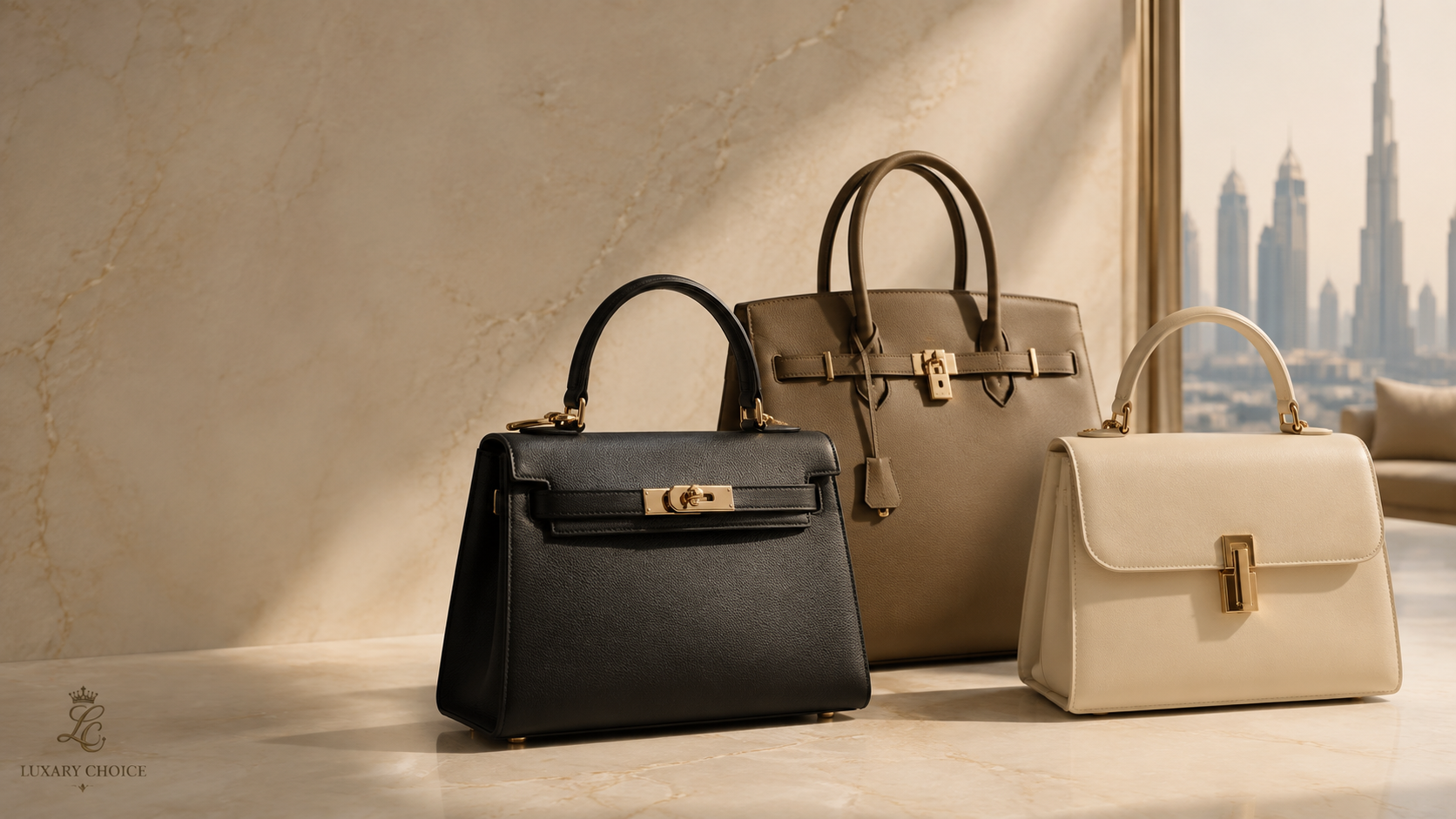
High quality replica bags are usually marketed around better materials, cleaner construction, stronger hardware, improved structure, and more careful finishing than low-grade imitation handbags. However, terms such as premium, master copy, mirror quality, and 1:1 are marketing labels rather than universal manufacturing standards. Two sellers can use the same quality term for products built very differently.
That means buyers should judge a bag by its actual construction, not by the grade written in a product title.
A bag can look impressive in photographs yet disappoint because the handles feel weak, the edge paint cracks, the lining is poorly fitted, or the hardware loses its finish quickly. On the other hand, a well-made bag usually feels consistent from the exterior material to the stitching, structure, zipper movement, lining, and small finishing details.
The most useful question is therefore not:
“What grade is this replica bag?”
It is:
“How well is this particular bag actually made?”
This guide explains the practical details that matter when comparing replica handbag quality, without relying on vague quality labels alone.
What Does “High Quality” Actually Mean for a Replica Bag?
A well-made handbag should feel coherent.
The material, stitching, hardware, lining, shape, handles, and closures should all feel as though they belong to the same quality level.
A useful comparison looks like this:
| Quality Area | Better-Made Bag | Lower-Quality Bag |
|---|---|---|
| Exterior material | Consistent texture and finish | Plasticky or inconsistent surface |
| Stitching | Straight and evenly spaced | Crooked, loose, or irregular |
| Structure | Holds intended shape | Collapses or twists easily |
| Edges | Smooth and neatly finished | Rough, cracked, or messy |
| Hardware | Consistent finish and secure attachment | Lightweight, loose, or uneven |
| Zippers | Smooth movement | Sticking or rough action |
| Lining | Neatly fitted | Loose, wrinkled, or poorly attached |
| Handles | Firm and balanced | Weak, uneven, or poorly reinforced |
No single detail proves overall quality. The bag should perform well across several areas.
Material Quality Comes First
The exterior material usually has the biggest influence on how a handbag feels.
Replica handbags can use different materials, including leather, coated canvas, synthetic leather, fabric, suede-style materials, and combinations of these.
Luxary Choice’s current catalogue, for example, lists products using materials described as calfskin, lambskin, suede, coated fabrics, and structured canvas depending on the item.
What Should You Look For in Leather?
Good leather should not simply feel soft.
Consider:
- texture consistency
- flexibility
- surface finish
- thickness
- smell
- how the material bends
- whether different panels feel similar
Extremely soft leather is not automatically better. A structured tote may require firmer leather than a relaxed shoulder bag.
The material should make sense for the shape and intended structure of the bag.
What About Coated Canvas?
A coated canvas bag should feel flexible enough for daily handling while maintaining its printed or textured surface.
Poor-quality coated material may feel excessively stiff, thin, or plasticky.
Again, the right evaluation depends on the bag style rather than one universal texture.
Stitching Reveals More Than Most Product Photos
Stitching is one of the easiest construction details to inspect.
Look closely around:
- handles
- corners
- straps
- zipper areas
- pockets
- flap edges
- structural seams
Better stitching tends to be:
- evenly spaced
- straight
- properly tensioned
- free from loose thread
- clean around corners
The most important areas are not always the decorative seams visible from the front.
Stress point matter more.
A beautiful line of stitching across a flap means little if the handle attachment is weak.
Check Reinforced Areas
Handles and shoulder straps carry most of the bag’s weight.
Look at where they meet the body.
These areas should feel secure rather than simply decorative.
For a daily-use handbag, structural stitching matters more than cosmetic perfection.
Edge Finishing Can Separate Good Construction From Cheap Construction
Many leather and synthetic-leather bags use edge paint or glazing along cut edges.
You may see it around:
- handles
- straps
- flaps
- leather tabs
- exposed panel edges
Good edge finishing should look controlled and smooth.
Warning signs include:
- thick blobs
- exposed raw edges
- uneven application
- cracking
- peeling
- colour bleeding
This detail is easy to ignore in online photos because sellers usually photograph the bag from a distance.
Close-up images are much more useful.
Hardware Should Feel Consistent With the Bag
Hardware includes:
- zipper pulls
- buckles
- clasps
- rings
- chain straps
- feet
- hooks
- magnetic closures
A better-made handbag usually has hardware that feels securely attached and operates smoothly.
It does not necessarily need to feel extremely heavy. Different designs use different hardware weights.
Instead, focus on consistency.
If one buckle feels solid while another feels loose and thin, quality control may be inconsistent.
Check the Finish
Look for:
- even colour
- clean surfaces
- no obvious flaking
- no rough edges
- securely fitted screws or pins
Gold-tone, silver-tone, black, and antique-style hardware can all look good when the finish is applied evenly.
Zippers and Closures Matter More in Daily Use Than Decorative Details
A handbag may be opened dozens of times each week.
That makes zipper performance important.
A good zipper should move smoothly without requiring excessive force.
Check:
- whether the zipper catches
- whether both sides align
- whether the pull feels secure
- whether the teeth look consistent
- whether the zipper sits flat
The same applies to:
- turn locks
- magnetic closures
- snap buttons
- hooks
A bag can look excellent on a shelf but become frustrating if the main closure is difficult to use.
Shape and Structure Should Match the Bag Style
Some handbags are supposed to be rigid.
Others are intentionally soft and relaxed.
So “holds its shape” does not mean every bag should feel stiff.
For a structured tote, inspect whether:
- the base sits flat
- side panels stay balanced
- handles stand evenly
- corners remain defined
For a soft shoulder bag, look instead at whether the material drapes naturally without feeling weak or shapeless.
Watch for Distortion
Poor construction can show up as:
- one side higher than the other
- twisted handles
- uneven base
- crooked flap
- collapsed corners
These problems are easier to spot in front, side, and bottom photographs than in a single promotional image.
Interior Quality Should Not Be Ignored
Many buyers spend most of their time examining the outside of a bag.
But the interior usually receives more direct daily wear.
Check:
- lining material
- pocket construction
- zipper pockets
- seams
- attachment points
- cleanliness
- structure
A loose lining can bunch up or become caught in zippers.
A poorly attached internal pocket may fail even while the outside of the handbag still looks good.
For an everyday bag, interior construction deserves almost as much attention as the exterior.
“1:1”, “Master Copy” and Similar Terms Need Context
The replica market uses many quality labels.
Common terms can include:
- premium replica
- master copy
- super master
- mirror quality
- 1:1
The problem is that these labels are not standardized grading systems.
There is no single global rule defining what a “1:1” bag must contain or how a “master copy” must be manufactured.
One seller may use “master copy” for genuine-leather products.
Another may use the same term for a completely different quality level.
That is why the label should never replace product-specific information.
Instead, ask what the bag is actually made from and how it is constructed.
Product Photos Should Show More Than the Front
A front-facing product image tells you surprisingly little about real quality.
For a more useful assessment, look for several angles:
- front
- back
- sides
- bottom
- interior
- handles
- zipper
- hardware
- corners
- edge finishing
Close-up images are especially valuable for checking:
- stitching
- grain
- glazing
- hardware finish
- lining
If every image is heavily edited or photographed from a distance, it becomes harder to judge the physical construction.
Compare Photos Consistently
Lighting changes colour dramatically.
A cream bag photographed under warm indoor light may look beige, while the same colour outdoors may appear much lighter.
Focus first on construction details, then on exact colour.
Choose Quality According to How You Will Use the Bag
Not every buyer needs the same handbag.
A bag used twice per month for dinner does not face the same demands as a tote carried daily to work.
For Everyday Use
Prioritize:
- reinforced handles
- reliable zipper
- practical interior
- durable material
- comfortable strap
- stable structure
For Evening or Occasion Use
You may care more about:
- shape
- finish
- compact size
- hardware
- visual detail
For Travel
Pay more attention to:
- strap strength
- closure security
- internal organization
- weight
- capacity
This is a better way to evaluate quality than simply choosing the highest advertised grade.
What Usually Makes a Replica Bag Cost More?
Price differences can come from several factors.
These may include:
- exterior material
- lining material
- hardware
- size
- complexity
- construction
- finishing
- packaging
- production volume
A larger price does not automatically prove better quality.
The useful question is:
What physical difference am I paying for?
If one bag costs considerably more, there should ideally be a visible or measurable reason—better material, stronger construction, more complex detailing, or a different specification.
High Quality Does Not Mean Maintenance-Free
Even well-made bags wear over time.
Leather can scratch.
Edge paint can wear.
Hardware can develop marks.
Light-coloured materials can pick up colour transfer.
Structured bags can lose shape when overloaded.
Good care helps protect the construction you paid for.
Basic Handbag Care
Keep bags:
- dry
- away from prolonged direct sunlight
- away from excessive heat
- supported when stored
- protected from sharp objects
Avoid overfilling a structured bag simply because everything physically fits inside.
Too much weight can strain handles, stretch seams, and distort the base.
Common Quality Mistakes Buyers Make
One mistake is treating the quality label as proof.
Another is focusing only on the exterior material while ignoring hardware and construction.
A third is judging a bag from one front-facing image.
Buyers also sometimes assume a heavy bag must be better made. Weight alone tells you very little.
Finally, it is easy to confuse appearance with durability.
A handbag can photograph beautifully yet perform poorly under daily use.
Quality should be judged as a system:
material + construction + hardware + lining + structure + finishing.
How Luxary Choice Describes Its Bag Quality
Luxary Choice currently positions its Dubai/UAE collection around replica and master-copy bags, shoes, and fashion accessories, with the site emphasizing materials, craftsmanship, and quality control in its product positioning.
Its catalogue includes women’s and men’s bags alongside shoes, watches, clothing, and jewellery, with individual listings providing material and construction details for selected products.
For buyers comparing a particular bag, the useful approach is still to examine the individual product specification and construction details, rather than assuming every item in a broad quality category is identical.
Final Thoughts
When comparing high quality replica bags, ignore the grade name for a moment and inspect the handbag as a physical product.
Start with the material.
Then check stitching, especially around stress points. Look closely at edge finishing, handles, zippers, hardware, structure, and interior construction.
Next, think about how the bag will actually be used.
An evening bag does not need the same durability as a daily work tote. A travel bag needs stronger handles and secure closures. A structured handbag needs to hold its shape, while a soft shoulder bag should drape naturally.
Most importantly, remember that terms such as premium, 1:1, mirror, and master copy do not replace real product specifications.
A high-quality handbag should demonstrate quality through the details you can actually inspect.
For buyers who want to explore currently listed replica bags, shoes, and accessories in Dubai and across the UAE, Luxary Choice provides product categories and individual listings with material and specification information for selected items
Frequently Asked Questions
What are high quality replica bags?
The term generally refers to replica handbags marketed with better materials, construction, hardware, and finishing than lower-grade alternatives. However, there is no universal standard defining exactly what qualifies as “high quality.”
What should I check first when evaluating bag quality?
Start with material, stitching, structure, handles, hardware, zipper movement, edge finishing, and lining. These areas usually provide more useful information than a quality-grade label.
Does genuine leather automatically mean a better bag?
No. Leather type, thickness, tanning, finishing, cutting, and construction all matter. A poorly constructed genuine-leather bag can still perform worse than a well-made alternative material.
What does “master copy” mean?
It is a market term commonly used for higher-grade replica products, but it is not a standardized manufacturing classification. Product-specific material and construction information is more useful.
Is heavy hardware always better?
No. Hardware should feel secure, consistent, and appropriate for the design. Excessive weight is not automatically a sign of quality.
How important is stitching?
Very important, particularly around handles, straps, corners, and other stress points. Straight decorative stitching alone is not enough; structural seams should also be secure.
How can I judge a bag from online photos?
Look for multiple angles and close-ups showing corners, edges, handles, hardware, stitching, the base, and the interior. One front-facing image is not enough for a useful quality assessment.
Do expensive replica bags always last longer?
Not necessarily. Durability depends on material, construction, hardware, use, and care. A higher price only makes sense when it corresponds to meaningful product differences.
![Gucci Copy Bag Price in Dubai [2026]: Complete Cost Guide](https://www.luxarychoice.com/wp-content/uploads/2026/06/Gemini_Generated_Image_aii6jaii6jaii6ja-768x414.png)