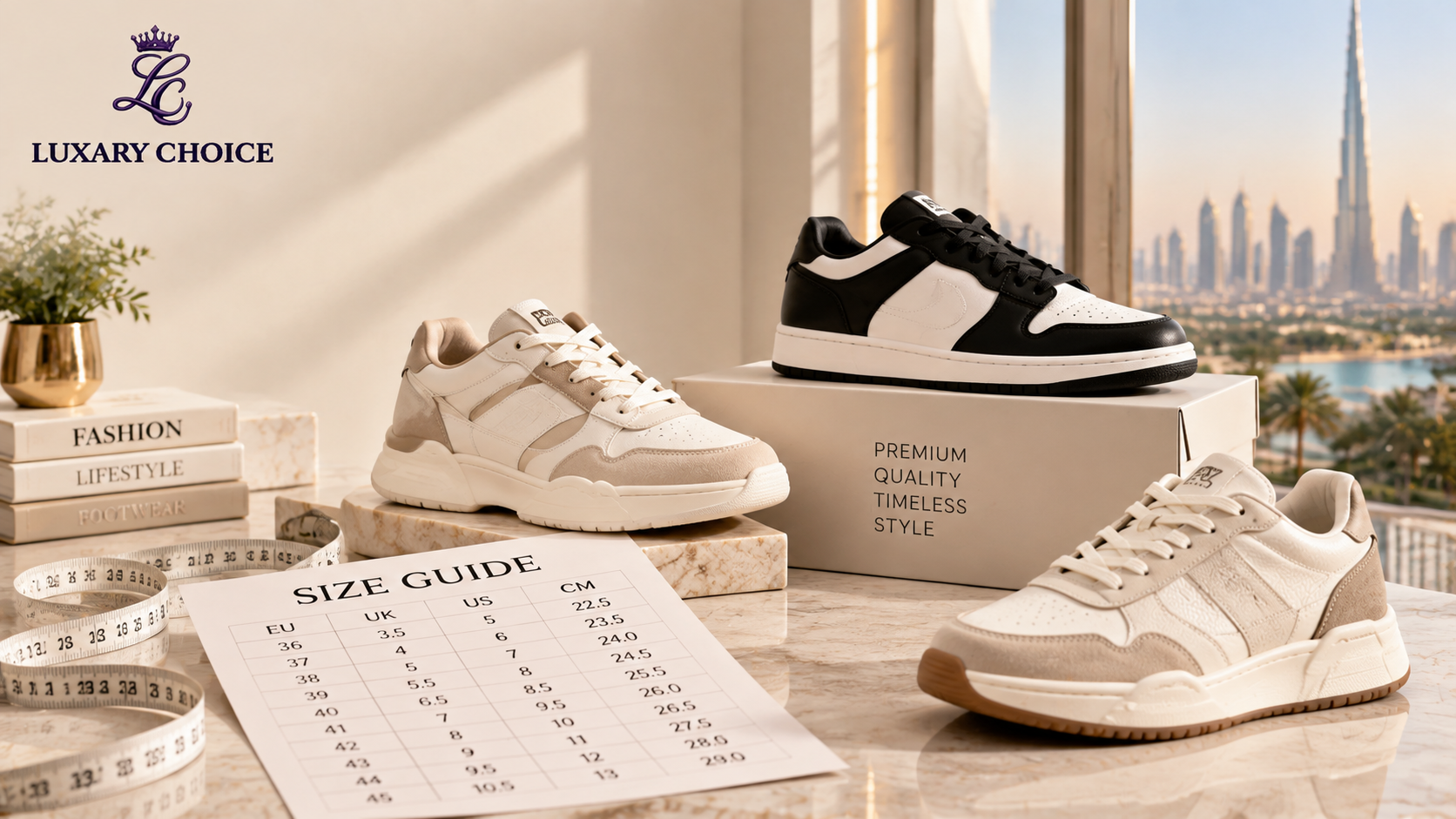
Buying shoes online becomes much easier when you stop treating the number printed on the box as the only sizing information that matters. For replica shoes size guide UAE, this is especially important because an EU 42 from one factory or shoe style may not fit exactly like an EU 42 from another.
The safest approach is to begin with your actual foot length and width, then compare those measurements with the size information for the exact pair you are considering.
International sizing itself is not perfectly uniform. ISO 19407:2023 provides conversion guidance between major footwear systems, but ISO explicitly notes that conversions are guidelines because sizing systems have developed differently over time. The standard treats foot length as the logical starting point for shoe sizing.
That leads to the most useful rule in this entire guide:
Measure your feet first. Use EU, UK or US size labels second.
A familiar size is a useful reference, but it should not replace measurements, shoe-shape information, or seller-specific fit guidance.
Why Replica Shoe Sizing Can Be Confusing
Most people already know their usual shoe size.
The problem starts when that size is treated as universal.
A person who normally wears EU 42 may find one sneaker comfortable in EU 42, another tight through the toe box, and a chunky trainer slightly loose in the same marked size.
This variation is not unique to replica footwear. NHS footwear guidance notes that shoe sizes can vary between makes and styles and recommends treating a measured shoe size as a guide rather than assuming it will transfer perfectly to another shoe.
With replica shoes, another layer of variation can appear because different production batches or factories may use different lasts, internal shapes, padding and construction methods.
So when a listing says “true to size,” that information is useful—but it should not be your only sizing check.
The better question is:
True to which size chart, and for what foot shape?
Start With Foot Length, Not Your Favourite Shoe Size
The most reliable starting point is measuring your foot from the back of the heel to the longest toe while standing.
ISO’s Mondopoint system is built around foot length measured in millimetres, which shows why physical foot measurement is more informative than relying only on a regional size label.
For online shopping, you do not need specialist equipment to get a useful measurement.
How to Measure Your Feet at Home
Place a sheet of paper on a hard, flat floor and stand on it with your normal body weight on the foot.
Mark the back of the heel and the end of the longest toe, or trace the foot carefully. Measure the distance between those points in centimetres or millimetres.
Repeat the process for both feet.
Use the larger foot when selecting shoe size.
NHS footwear guidance specifically recommends measuring both feet while standing and fitting to the larger foot because differences between the two feet are common.
Measure Later in the Day if Your Feet Swell
Feet can become slightly larger after standing, walking or being active through the day.
NHS guidance therefore recommends measuring or trying shoes in the afternoon or evening, particularly for people whose feet tend to swell.
For a UAE buyer, this can be particularly useful if you spend much of the day walking, commuting or standing.
A shoe that is just comfortable first thing in the morning can feel very different several hours later.
Measure With the Socks You Will Actually Wear
Your foot is not the only thing occupying space inside a shoe.
Sock thickness matters.
If you are buying chunky sneakers or casual trainers that you normally wear with thicker socks, measure and evaluate fit with that type of sock in mind.
If you are choosing loafers that you wear with thin socks, the fit requirement may be different.
NHS footwear advice recommends wearing the same type of socks, stockings or insoles you expect to use with the shoe when checking fit.
This sounds like a minor detail, but it can be the difference between a comfortable pair and a shoe that feels too tight once worn normally.
Foot Width Matters Almost as Much as Length
Online size guides often focus only on length.
Feet are three-dimensional.
Two people can both measure 27 cm from heel to toe while needing very different shoes because one has a narrow forefoot and the other has a wide forefoot.
ISO’s Mondopoint system recognises this by using foot length as the primary measurement and foot width as an additional characteristic.
That means someone with a wide foot should not automatically solve every fit problem by buying a longer shoe.
Going up a full size may create:
- too much heel movement,
- excess toe length,
- unstable walking,
while still not providing the ideal width.
A better solution may be a model with a wider toe box or a different internal shape.
EU, UK and US Sizes Are Conversions, Not Perfect Equivalents
UAE online footwear listings frequently show combinations of:
- EU size,
- UK size,
- US size.
These systems are related, but they are not simply three different labels for a perfectly identical physical shoe size.
ISO 19407:2023 provides conversion tables between European, UK, US and other systems, but specifically describes the conversions as guidance because the systems have developed differently.
So if you normally wear:
EU 43
do not automatically choose a US or UK conversion from a random internet chart and assume the result is exact.
For online replica shoes, use this order:
foot length → exact listing’s size information → familiar EU/UK/US size as a cross-check
rather than the other way around.
Why Your Usual EU Size Can Still Fit Differently
EU sizing is popular because it appears simple.
But the size marking does not tell you the complete internal shape of the shoe.
Fit can change because of:
- toe-box shape,
- heel construction,
- internal padding,
- upper stiffness,
- insole thickness,
- shoe last,
- overall silhouette.
A pointed loafer and a wide basketball-style sneaker can both carry the same EU size while feeling completely different.
This is why the existing Luxary Choice shoe guide’s general advice to use EU sizing should be treated as the starting reference, not as a guarantee that every shoe in the catalogue will fit identically. Luxary Choice’s current buying guide also recommends supplying foot measurements in centimetres when sizing help is needed.
Sneakers, Loafers and Heels Should Not Be Sized the Same Way
The type of shoe matters because different styles hold the foot differently.
Sneakers
Sneakers usually need enough length and width for natural toe movement while still holding the heel securely.
Heavily padded sneakers can feel tighter internally even when their outside dimensions look large.
Chunky trainers can create the opposite problem: their large exterior shape may make buyers assume they run large when the internal fit could still be relatively standard.
For replica sneakers, ask about the actual fit of the specific model or batch rather than assuming every sneaker follows the same rule.
Loafers
Loafers do not use laces to lock the foot down.
That makes heel fit particularly important.
If a loafer is too large, your heel may lift with every step.
If it is too small, pressure across the forefoot can become uncomfortable quickly.
A person between sizes should therefore consider both length and width rather than automatically sizing up.
Heels
Heels create a different fit problem because the foot can move forward toward the front of the shoe.
Toe-box shape, heel height and overall construction matter as much as the number printed on the sole.
A pointed-toe design can feel tighter than a round-toe design in the same labelled size.
For fashion footwear, style-specific fit guidance is more valuable than a generic conversion chart.
Should Replica Shoes Fit Exactly Like the Original Model?
Do not assume they will.
Even when a replica closely follows the appearance of a particular shoe, visual similarity does not prove identical internal sizing.
The fit can change because the replica may use a different:
- last,
- insole,
- lining,
- padding density,
- sole construction,
- upper material.
This is a major content gap in many replica shoe guides.
A shoe can look very close externally while fitting differently internally.
Therefore:
Do not use the retail version’s official size chart as the only sizing evidence for a replica pair.
If the seller provides measurements or model-specific sizing guidance for the actual pair being sold, that information is more relevant.
Does Master Copy or 1:1 Quality Guarantee Accurate Sizing?
No.
A higher quality tier may involve better materials, construction or finishing, but quality grade is not a sizing standard.
Terms such as:
- master copy,
- 1:1,
- premium replica,
- first copy,
do not create an internationally regulated shoe-size specification.
So a “master copy EU 42” should not automatically be assumed to fit exactly like another factory’s EU 42.
Luxary Choice’s existing master-copy shoe guide focuses on construction quality, materials and production tiers. That content can remain the site’s main quality guide, while this page should own the separate problem of fit and sizing.
How Useful Is Insole Length?
Insole measurements can be helpful, but they need to be interpreted correctly.
A removable insole is normally longer than the foot it is designed to accommodate because a shoe needs some space beyond the toes.
So if your foot measures 27 cm, you should not automatically look for an insole measuring exactly 27 cm.
Doing that may leave insufficient toe room.
The value of insole length is comparative.
For example, if you already own a comfortable sneaker with a removable insole, you can measure that insole and compare it with the insole measurement provided for the new pair.
That can sometimes be more useful than comparing only printed sizes.
However, insole shape and internal shoe volume still matter.
A 28 cm insole inside a narrow shoe may not fit like a 28 cm insole in a wide shoe.
How Much Toe Room Should a Shoe Have?
A shoe should not force the longest toe against the front during normal standing and walking.
NHS podiatry guidance commonly recommends allowing room beyond the longest toe and ensuring that the toe box is wide enough for the toes rather than squeezing them together.
This does not mean every shoe should feel visibly oversized.
The foot should remain secure at the heel and midfoot while the toes have enough room to move naturally.
If you constantly feel pressure at the front of the shoe while standing, the fit is probably too short or the toe box is unsuitable.
What If You Are Between Two Sizes?
This is where a simple “always size up” rule becomes unreliable.
Suppose your foot measurement falls between two listed sizes.
Your decision should depend on the shoe.
If the model:
- runs narrow,
- has heavy internal padding,
- has a pointed toe,
the larger size may be more comfortable.
If the model:
- runs long,
- has a wide toe box,
- is a slip-on loafer,
the larger size may create excessive heel movement.
Instead of blindly sizing up, compare:
foot length + foot width + model shape + seller fit note
If those still leave uncertainty, ask for a measurement from the exact pair.
Wide Feet Need More Than “Size Up One”
People with wider feet frequently solve every fit problem by going up one size.
That can work occasionally, but it is not always the best solution.
A longer shoe may still pinch at the widest part of the foot while leaving unnecessary empty space in front of the toes.
When possible, ask about:
- toe-box width,
- forefoot width,
- whether the model runs narrow,
- whether the upper material has flexibility.
If you regularly struggle with narrow footwear, tell the seller your foot length and that you have a wider forefoot.
That is more useful than saying only:
“I normally wear size 43.”
Do Not Assume Shoes Will “Break In” Enough to Fix the Wrong Size
Some materials soften slightly with use.
That does not mean an obviously tight shoe should be purchased with the expectation that it will eventually become the correct size.
NHS footwear guidance advises that shoes should fit properly when new rather than depending on a future break-in period to correct poor fit.
This is particularly important for online purchases because an unworn shoe is much easier to exchange than one that has already been worn outside trying to stretch it.
A Practical Online Sizing Example
Imagine you normally wear EU 42.
Instead of immediately ordering EU 42, you measure both feet.
Your larger foot measures 26.8 cm.
Now you have two pieces of information:
usual size: EU 42
actual foot length: 26.8 cm
You then check the exact shoe listing or ask for sizing guidance.
If that pair’s recommended chart places 26.8 cm within EU 42 and the model is described as normal width, EU 42 becomes a stronger decision.
If the seller says that particular model fits narrow and you have wide feet, you now know there may be a fit issue even though the size number appears correct.
That is the value of measuring.
It turns sizing from guessing into comparison.
What Information Should You Send When Asking for Size Help?
Instead of messaging:
“I wear 42. What size?”
give enough information to make the answer useful.
A better message would include:
Foot length: 26.8 cm
Usual size: EU 42
Foot width: normal / wide
Shoe: exact model
Fit preference: snug / normal / slightly roomy
If you use thick socks or an orthotic/insole, mention that too.
NHS footwear guidance confirms that the socks and insoles used with footwear can affect fit.
What to Check When the Shoes Arrive
Online sizing does not end when the package arrives.
Try the pair on indoors before wearing it outside.
Put on the socks you expect to use normally and try both shoes, not just one.
Walk around for several minutes.
Pay attention to:
- heel slipping,
- toe pressure,
- forefoot tightness,
- arch discomfort,
- rubbing,
- one shoe fitting differently from the other.
NHS advice recommends trying both shoes, walking in them and checking that the heel remains secure while the shoe provides enough width and toe space.
If the fit is clearly wrong, do not wear them outdoors hoping the problem disappears.
That can make an exchange more difficult.
Why Return and Exchange Terms Matter Before You Order
Sizing uncertainty is part of buying shoes online.
That makes the exchange policy part of the sizing decision—not something to investigate after the shoes arrive.
Luxary Choice’s current UAE shoe-buying guide states that sizing exchanges are available where the shoes remain unworn and tags are retained, subject to its current terms.
Because policies can change, check the live terms before purchasing.
The important questions are:
- Is size exchange allowed?
- How quickly must it be requested?
- Must all packaging and tags remain?
- Who pays return delivery?
- Are sale/custom items treated differently?
A pair that is slightly cheaper but impossible to exchange may create more risk than a pair supported by a clear size-swap process.
UAE Buyers Should Avoid Random International Size Charts
Search engines contain hundreds of shoe conversion tables.
Many are approximately correct.
The problem is that approximately correct may not be good enough for a specific shoe.
ISO itself notes that size-system conversions are guidelines rather than perfect universal mappings.
So do not combine:
a random US-to-EU chart
- a seller’s EU listing
- the size of an unrelated shoe
and assume the result is exact.
Use conversion charts only as a cross-check.
Foot measurement and model-specific information should remain the primary decision tools.
Common Sizing Mistakes When Buying Replica Shoes Online
Ordering From Memory
Your feet can change over time, and different styles fit differently.
Measure again instead of assuming your size from several years ago is still ideal.
Measuring Only One Foot
Most people have some difference between their feet.
Fit to the larger one.
Measuring While Sitting
Standing gives a more realistic measurement because the foot spreads under body weight. ISO and NHS guidance both use standing/weight-bearing measurements as the basis for fit assessment.
Ignoring Width
A correct length does not guarantee a comfortable shoe.
Assuming Every EU 42 Is Identical
Sizing varies by brand, style and construction.
Sizing From the Original Retail Version Only
A replica pair may not use an identical internal last.
Buying Tight Shoes Because “They Will Stretch”
A little material softening is different from correcting the wrong size.
Wearing the Shoes Outside Before Confirming Fit
If an exchange is needed, this can create unnecessary problems.
How This Guide Differs From Luxary Choice’s Existing Shoe Content
Luxary Choice already has broader content about where to buy copy shoes in the UAE, including Dubai, Sharjah and Abu Dhabi, and that page briefly mentions shoe sizing and exchanges.
The site also has a dedicated master copy shoes Dubai guide covering quality tiers, materials and construction.
This article should not duplicate either one.
Its purpose is narrower:
measure → convert → assess width → understand shoe shape → confirm model fit → check exchange terms
That gives it a distinct search intent and creates a useful supporting page for the footwear cluster.
Final Thoughts
The best replica shoes size guide UAE buyers can follow is not a giant EU-to-US conversion chart.
It is a measurement process.
Start with your actual feet.
Measure both while standing. Use the larger measurement. Consider width. Wear the socks you normally use. Then compare those measurements with the exact shoe you want to order.
That approach reflects the logic behind international footwear standards. ISO 19407:2023 bases footwear size conversion on foot length and explicitly warns that conversions between major sizing systems remain guidelines because those systems have evolved differently.
It also reflects practical footwear advice: NHS sources consistently recommend measuring both feet, fitting to the larger one, checking shoes later in the day when appropriate, and remembering that fit can vary between different shoe brands and styles.
For online replica footwear, add one more rule:
Do not assume visual accuracy means sizing accuracy.
A high-quality shoe can still fit differently from another pair carrying the same EU number.
So use this order:
foot length → width → shoe type → model-specific fit → size label → exchange policy
Luxary Choice’s existing UAE shoe guide already recommends providing foot measurements in centimetres when sizing assistance is needed and describes its current size-exchange approach for unworn footwear.
Frequently Asked Questions
How do I know my replica shoe size when buying online?
Measure both feet while standing, use the larger foot, and compare the heel-to-toe length with the sizing information for the exact shoe. Your usual EU, UK or US size should be used as a secondary reference rather than the only sizing method.
Are replica shoes true to size?
Some may fit close to standard sizing, while others can run small, large, narrow or wide depending on the factory and shoe construction. “True to size” is useful model-specific guidance, not a guarantee across all replica footwear.
Should I use EU or UK sizing when buying replica shoes in the UAE?
Either system can work if the seller provides reliable size information, but EU sizes are commonly used in UAE footwear listings. The safest method is still to compare your foot length with the exact listing rather than relying only on a conversion.
How do I measure my foot for shoes online?
Stand on paper, mark or trace the heel and longest toe, and measure the distance. Measure both feet and use the larger measurement. Measuring later in the day can be useful if your feet tend to swell.
Should I size up if I have wide feet?
Not automatically. A larger size adds length but may not solve a width problem. Check whether the specific model runs narrow or has a wide toe box, and provide both length and width information when asking for sizing advice.
Is insole length the same as foot length?
No. Insoles normally contain some additional space beyond the foot. Insole length can be useful for comparing a new shoe with a comfortable pair you already own, but it should not be treated as identical to heel-to-toe foot length.
Should replica shoes fit exactly like the original shoes?
Not necessarily. A replica may look very similar externally while using different internal padding, lasts, insoles or materials. Model-specific sizing information for the actual pair is more useful than assuming identical fit.
What should I do if I am between two shoe sizes?
Consider foot width, shoe shape, padding and seller fit guidance. A narrow padded sneaker may justify the larger option, while a long or loose loafer may not. Ask for exact model measurements if the difference is unclear.
When should I try new shoes on?
Try them later in the day if your feet tend to swell, wear your usual socks, try both shoes and walk around indoors before deciding whether the fit is correct.
Can I exchange replica shoes if the size is wrong?
That depends on the seller’s current policy. Luxary Choice’s existing shoe guide states that size exchanges may be available for unworn shoes with tags retained, so buyers should verify the current conditions before ordering.




![Replica Louis Vuitton Bag Price in Dubai [2026]: Complete Cost Guide](https://www.luxarychoice.com/wp-content/uploads/2026/06/Untitled-design-4-768x429.png)